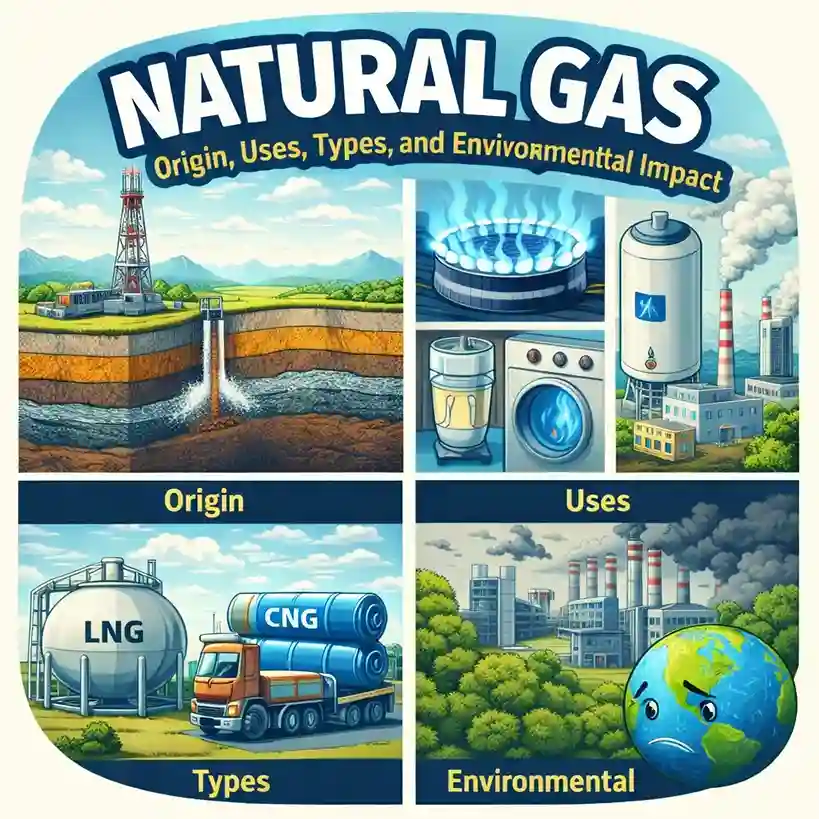
Natural Gas: Formation, Types, Uses, and Environmental Impact
Natural gas is one of the most widely used energy resources in the world today. It fuels kitchens as LPG, powers vehicles as CNG, generates electricity, and supports large-scale industries such as fertilizers, chemicals, and hydrogen production. Like coal and petroleum, natural gas is a fossil fuel formed over millions of years from the remains of plants, animals, and microorganisms buried deep beneath the Earth’s surface. While often taken for granted, natural gas has a complex formation process, various types, and significant global importance.
Origin of Natural Gas
The term “natural gas” first appeared in English around 1825, although people initially just referred to it as “gas.” Natural gas is a non-renewable energy source, closely linked to coal and crude oil. Millions of years ago, microscopic marine organisms like algae and plankton died and settled on the ocean floor. Due to low oxygen levels, these organic materials transformed into a waxy substance called kerogen.
Over millions of years, heat from the Earth and pressure from overlying rock layers converted kerogen into hydrocarbons, forming oil and natural gas. At the molecular level, natural gas is primarily methane (CH₄), mixed with ethane, propane, butane, pentane, carbon dioxide, and water vapor. These hydrocarbons migrate through porous rocks and accumulate in underground reservoirs, sometimes leaking to the surface.
Natural Gas Reservoirs and Exploration
Natural gas is stored in large underground reservoirs formed in rock folds and faults. These reservoirs act like sponges, with some being as large as entire cities. To locate them, geologists and energy companies use seismic, geological, and gravitational surveys. During seismic surveys, sound waves are sent underground, and the reflections produce 3D and 4D images that help identify gas deposits. Natural gas reserves are found both on land and beneath the ocean floor.
Composition of Natural Gas
Raw natural gas extracted from reservoirs is called “wet natural gas” because it contains methane along with liquid hydrocarbons such as ethane, propane, butane, and pentane. It also contains impurities like carbon dioxide and water vapor. After processing, it becomes “dry natural gas,” which is primarily methane and ready for industrial and domestic use.
Types of Natural Gas
Natural gas can be classified based on its source and extraction methods:
- Conventional Gas: Found in porous rocks that allow the free flow of gas.
- Biogas: Produced by decomposing organic matter such as plant waste or animal dung, making it a renewable energy source.
- Deep Natural Gas: Found 4–5 km below the surface; extraction is technically difficult.
- Shale Gas: Trapped in sedimentary shale rock, extracted using hydraulic fracturing (fracking) and horizontal drilling.
- Tight Gas: Located in dense rock layers; requires fracking and acidizing for extraction.
- Coal Bed Methane: Released from coal seams, now extracted as a valuable resource.
- Geo-pressurized Zones: Found 3–7.5 km underground, containing large amounts of gas, extraction is extremely challenging.
The United States relies heavily on fracking, extracting 75% of its natural gas through this method, though it has serious environmental consequences.
Global Natural Gas Reserves
According to the Energy Information Administration, the Earth contains approximately 6,289 trillion cubic feet (TCF) of natural gas. Russia holds the largest share (24.3%), followed by Iran (17.3%) and Qatar (12.5%). The United States has 5.3%, Saudi Arabia 4.2%, and India only 0.7%, requiring imports to meet its energy needs. In 2022, India imported petroleum gas worth $32 billion, mainly from Qatar, UAE, and Saudi Arabia.
History of Human Use
Humans have been using natural gas for only a few thousand years, despite its ancient geological origin. Around 500 BCE, Chinese engineers used bamboo pipelines to transport gas for heating water. By the 17th century, British companies began large-scale production, using natural gas for street lighting and household purposes.
Major Uses of Natural Gas
The primary use of natural gas globally is electricity generation. For example, the United States generates 36% of its electricity from natural gas. It is also widely used for heating homes, industrial processes, water heating, cooking, air conditioning, and transportation.
In India, the fertilizer industry consumes around 32% of imported natural gas. Other sectors, such as petrochemicals, sponge iron, and hydrogen production, also rely heavily on this resource. Major corporations in the natural gas sector include Saudi Aramco, ExxonMobil, Chevron, Reliance Industries, PetroChina, and Shell. Saudi Aramco alone produces around 10 million cubic feet of gas daily.
Environmental Impact
Although natural gas is considered cleaner than coal and oil, it still contributes to climate change. Methane is a potent greenhouse gas, and leaks during extraction, transportation, or storage significantly impact the environment. Fracking contaminates groundwater, consumes millions of gallons of water per well, and can induce minor earthquakes.
Pipelines spanning over 1.1 million kilometers globally also pose risks. Pipeline explosions or leaks release massive amounts of methane, harming local communities and ecosystems. For example, the 2022 North Stream pipeline explosion released 478,000 tons of methane into the atmosphere.
Health Impacts
Communities near natural gas sites face health hazards, including respiratory issues, asthma, cardiovascular problems, cancer, and pregnancy complications. Exposure to nitrogen oxides and volatile organic compounds from gas processing increases ground-level ozone, causing lung infections and other severe health problems.
The Need for Renewable Alternatives
Despite its utility, global dependence on natural gas contributes to climate change and environmental degradation. Reducing reliance on fossil fuels and transitioning to renewable energy sources such as solar, wind, geothermal, and hydroelectric power is crucial for a sustainable future. These alternatives provide cleaner energy solutions and help protect public health and the environment.
Conclusion
Natural gas has played a vital role in human development, powering homes, industries, and transportation for centuries. However, its extraction and consumption pose significant environmental and health challenges. While it is cleaner than coal or oil, methane leaks, fracking, and pipeline hazards make its long-term use unsustainable without caution. The world must invest in renewable energy alternatives, reduce fossil fuel dependence, and adopt cleaner technologies to protect our planet. Responsible energy management today will ensure a sustainable, healthier, and safer environment for future generations.