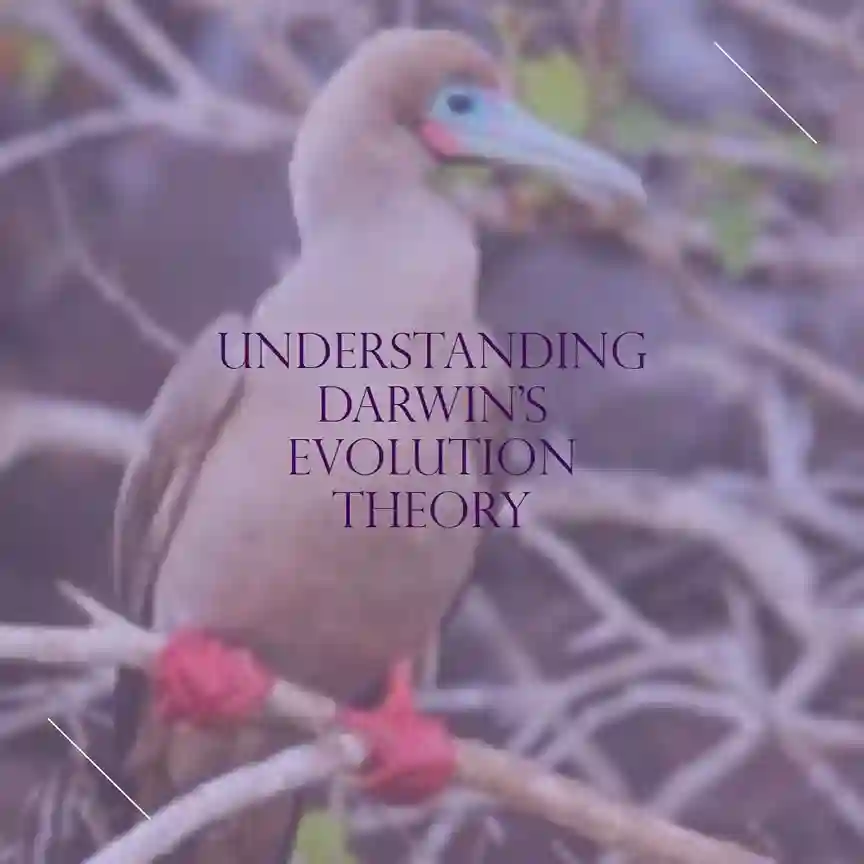
Charles Darwin and the Theory of Evolution Explained
Charles Darwin is a name that instantly brings to mind the theory that explains why we and all living beings exist today. This is the Theory of Evolution, which Darwin elaborated in his famous book On the Origin of Species. Evolution helps us understand how living beings adapt to their surroundings and survive over millions of years.
Natural Selection: Survival of the Fittest
Darwin’s concept of natural selection is simple yet profound. Imagine a child born in Rajasthan whose father is transferred to Himachal Pradesh. Initially, the child would feel cold, fall sick, and struggle to survive. By adapting to the environment—wearing warm clothes and protecting themselves—they learn to survive. Similarly, millions of years ago, plants, animals, and humans survived by adapting to their surroundings. Those who could not adapt went extinct.
“Survival of the fittest” does not mean the strongest physically. It refers to the ability to adjust to the environment efficiently. For instance, giraffes have long necks to reach high tree leaves, and flying fish can leap above water to escape predators.
Common Ancestry: The Tree of Life
All living beings share a connection through a common ancestor. If we trace a family tree backwards, it goes from parents to grandparents and beyond. Similarly, life on Earth traces back approximately 4 billion years to the first living cell, known as FUCA (First Universal Common Ancestor). This one-celled organism was neither fully living nor non-living but eventually gave rise to all life forms.
Key Principles of Evolution
Darwin’s theory is based on two major points:
- All life on Earth is interconnected.
- The diversity of life arises through natural selection.
Natural selection works alongside reproduction. Variations occur through size, color, behavior, and other traits. For example, frogs can live both in water and on land. Changes from small-scale variations to large transformations are categorized as:
- Microevolution: Small changes within a species over time.
- Macroevolution: Large-scale changes, such as dinosaurs evolving into birds.
- Sexual evolution: Traits that help attract a mate, such as a peacock displaying its feathers.
Genetic Basis of Evolution
Before DNA was discovered, Darwin already proposed the mechanism of evolution. Today, we know that natural selection works at the genetic level. Mutations in DNA introduce variations among living beings. These mutations can be positive, like the presence of six fingers in a particular family in Brazil, or negative, such as genetic disorders from close-relative marriages.
DNA carries genes, which act like hard drives storing all information about an organism’s characteristics, behavior, and traits. Reproduction increases variety because the more offspring produced, the more chances of diversity. This variation is influenced by:
- Heredity: Passing DNA to the next generation.
- Recombination: Mixing DNA from different individuals to produce new variations.
- Mutation: Sudden changes in DNA due to factors like radiation.
Mutations can be negative, leading to diseases, or positive, giving rise to traits such as blue eyes in humans.
Adaptation and Environmental Influence
The survival of a species depends on how well it fits into its environment. For example, pit bulls may survive better in dangerous surroundings compared to smaller dogs. Evolution encourages organisms to produce more varied offspring, ensuring that at least some survive under changing conditions.
Humans also show evolution in action. Crossbreeding between individuals from different climates can produce stronger, healthier, and more intelligent offspring. For instance, people from Himalayan regions have shorter average height to adapt to cold environments, while their descendants with cross-climatic marriages may inherit a taller stature or stronger immunity.
Real-Life Examples of Evolution
Evolution is not just a historical concept; it continues today. Consider mountain climbers like Manoj Sherpa or Ang Rita, who adapted to extreme low-oxygen environments over generations. Their bodies can efficiently use minimal oxygen, a trait developed through long-term adaptation. Similarly, Bajau people from Indonesia, Malaysia, and the Philippines can hold their breath for 15 minutes underwater due to adaptations in the spleen and lungs, illustrating ongoing evolution.
Modern Factors Affecting Human Survival
Today, natural selection is influenced by modern medicine, technology, vaccines, and antibiotics. Humans survive diseases and environmental challenges that might have been fatal in the past. Cancer survivors and people who recovered from viral outbreaks like COVID-19 are examples of survival aided by technology rather than just genetic adaptation.
Genetic Drift and Continuous Change
Evolution does not have a fixed endpoint. Genetic drift refers to the gradual loss or fixation of traits in a population over time. Isolated populations, like the Amish in Pennsylvania, show unique traits due to inbreeding, sometimes resulting in genetic disorders. Evolution occurs over millions of years but can also produce noticeable changes in a few generations, especially in extreme environments like Siberia, the Arctic, or underwater habitats.
Conclusion
Charles Darwin’s theory of evolution explains the interconnectedness and diversity of life on Earth. Through natural selection, adaptation, genetic variation, and reproduction, species evolve to survive and thrive. Evolution is a continuous process that occurs in all living beings, including humans, and is influenced by both nature and modern technology. Understanding evolution helps us appreciate the complexity of life, the significance of our genetic makeup, and our ability to adapt to an ever-changing world. The journey of evolution is ongoing, reminding us that life is dynamic, resilient, and continuously transforming.