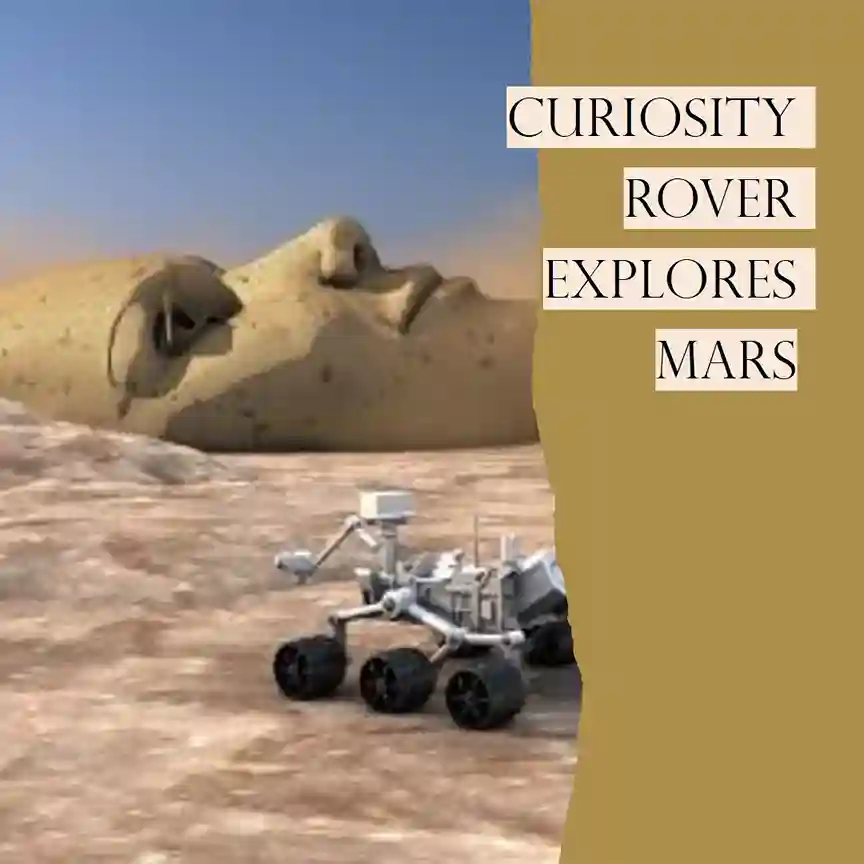
Curiosity Rover: Exploring Mars and Searching for Life
Imagine a robot the size of a six-wheeled car roaming the rocky surface of Mars for over a decade, investigating whether the Red Planet ever had conditions supportive of life. This remarkable machine is NASA’s Curiosity Rover, part of the Mars Science Laboratory mission, designed to explore Gale Crater and understand the planet’s geology, climate, and potential for past life.
Launch and Landing
Curiosity was launched from Cape Canaveral, Florida, aboard an Atlas V rocket on November 26, 2011, and arrived on Mars on August 5, 2012, after a journey of 8 months and 10 days. It landed in Gale Crater, a 154-kilometer-wide basin named after Australian astronomer Walter Gale. Scientists believe the crater formed over 3.5 billion years ago following a massive impact.
Landing on Mars was a tense operation, famously called the “Seven Minutes of Terror” due to the complex sequence involving parachutes, rockets, and a sky crane. Successfully touching down, Curiosity began its mission to explore Mars’ surface, setting a benchmark for robotic planetary exploration.
Rover Specifications and Capabilities
Curiosity is approximately the size of an SUV, 9 feet 10 inches long, 9 feet 1 inch wide, and 7 feet tall, weighing around 900 kilograms. Built by NASA’s Jet Propulsion Laboratory (JPL), the rover can traverse obstacles up to 25 centimeters in height and cover roughly 200 meters per day.
Its power source is a Multi-Mission Radioisotope Thermoelectric Generator (MMRTG), which converts heat from Plutonium-238 into electricity, allowing it to operate year-round in the harsh Martian environment.
The rover carries an array of scientific instruments, including:
- Mast Camera (Mastcam): captures high-resolution images (1600×1200 pixels) and 720p videos.
- Mars Hand Lens Imager (MAHLI): attached to the robotic arm for close-up images.
- Alpha Particle X-ray Spectrometer (APXS): analyzes chemical compositions of rocks and soil.
- Chemistry and Camera (ChemCam): uses a laser to vaporize materials and analyze emitted gases.
- 12 Engineering Cameras: provide navigation and backup imaging capabilities.
Additionally, Curiosity has a drill, scoop, dust removal tools, and a thermal regulation system to study soil samples and maintain instrument temperatures.
Scientific Objectives
Curiosity’s mission is not limited to capturing photographs or collecting rocks. Its primary scientific goals include:
- Investigating whether Mars ever had an environment capable of supporting microbial life.
- Studying the planet’s climate and geology.
- Preparing for future human exploration by assessing radiation, terrain, and resource availability.
To search for life, Curiosity is equipped with tools that detect hydrogen, an indicator of water presence, and analyze chemical gases released from heated soil and rock samples. By comparing these with pre-existing Earth-based samples, scientists determine whether Martian materials contain biologically relevant elements.
Key Discoveries
Since its landing, Curiosity has made several significant discoveries:
- In 2013, it detected sulfur, nitrogen, hydrogen, oxygen, phosphorus, and carbon in Martian soil—elements considered the building blocks of life.
- Evidence shows that billions of years ago, Mars had freshwater lakes, as indicated by sedimentary rocks in Gale Crater.
- Variation in methane concentrations suggests the potential presence of microbial life.
- Clay minerals formed by flowing water further support the idea of a habitable ancient environment.
- Studies reveal that Mars’ atmosphere gradually diminished, contributing to its current dry, cold state.
The rover has also provided vital data for human exploration. Its Radiation Assessment Detector measured radiation exposure, concluding that a round-trip Mars mission of 500 days on the surface would expose astronauts to approximately 1.01 sieverts, which is within hazardous limits for long-term human missions.
Challenges Faced
Curiosity’s mission has not been without challenges:
- Within six months of landing, a major computer glitch threatened to sever its connection with Earth. Engineers recovered it successfully.
- In 2016, a technical issue temporarily halted scientific operations, but it was resolved remotely.
- In 2020, Curiosity lost orientation, affecting some of its instruments, but calibration and software updates restored functionality.
Operating a rover millions of kilometers away involves constant monitoring, data analysis, and precise adjustments by teams of scientists and engineers. The rover has been resilient despite software, mechanical, and environmental challenges.
Mission Costs
NASA’s annual budget is approximately $24 billion. The Curiosity mission development, from 2004 to 2011, cost roughly $2.5 billion, including design, construction, testing, and the Atlas V launch. Its landing in 2012 cost $200 million, with ongoing operations running $20–30 million annually, including daily costs of $80,000–$85,000 for communication, data analysis, and ground support.
Achievements and Impact
Curiosity has traveled over 33 kilometers on Mars and has provided panoramic images, selfies, and even weather data. Its findings have proven Mars was once a habitable planet, guiding future missions like NASA’s Next Mars Orbiter (NEMO) and the 2030 human exploration plans using the Orion spacecraft.
The rover’s discoveries continue to inform scientists about planetary processes, potential life, and strategies for long-term human presence on Mars. Curiosity has not only answered key scientific questions but also inspired a generation of engineers, astronomers, and space enthusiasts worldwide.
Conclusion
The Curiosity Rover represents a milestone in planetary exploration. Its mission has provided critical insights into Mars’ past habitability, chemical composition, climate, and radiation environment. By collecting and analyzing soil and rock samples, Curiosity has laid the groundwork for future human exploration and deeper understanding of the Red Planet. Its resilience in overcoming technical challenges and providing continuous data over more than a decade exemplifies human ingenuity and the relentless quest to explore the unknown.
Mars exploration through Curiosity has not only advanced science but also inspired humanity to push boundaries and envision a future where humans may one day walk on another planet. The rover’s legacy will guide upcoming missions, ensuring that the search for life and understanding of Mars continues for decades to come.