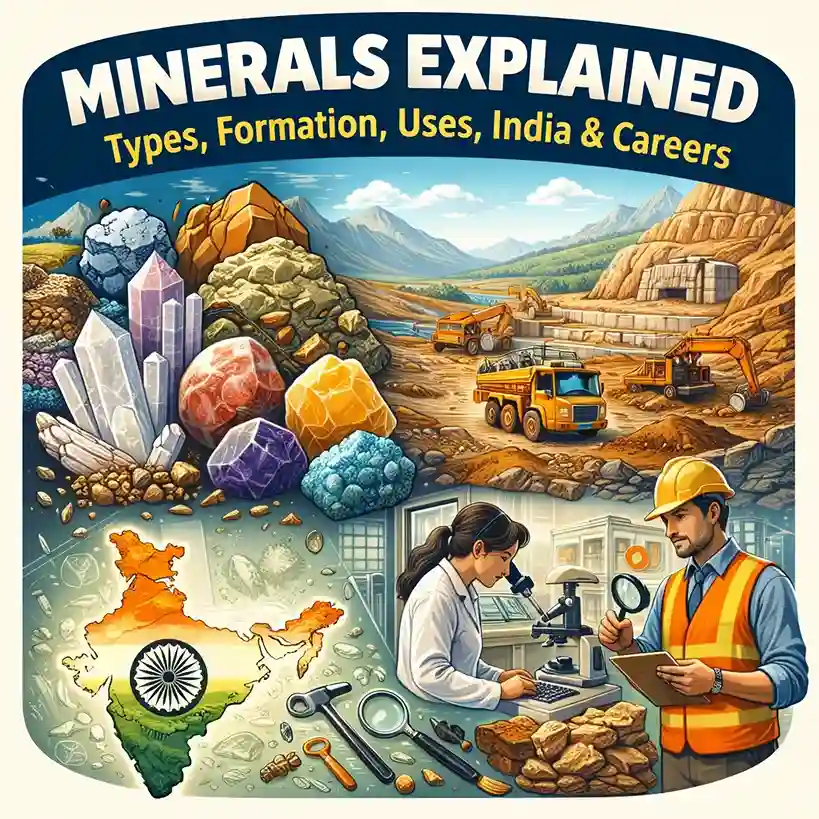
Minerals: Formation, Types, Uses, Indian Resources and Careers
Our Earth is rich in resources, and beneath its surface lies a hidden world full of treasures known as minerals. Minerals, also called mineral substances, are naturally occurring materials that have been formed through geological processes over millions and even billions of years. These substances are often described as the building blocks of our planet because they play a crucial role in shaping the Earth and supporting human civilization.
One of the most common minerals found in every household is salt. Its scientific name is sodium chloride, or NaCl. From simple salt to precious gold and diamonds, minerals are present everywhere in our daily lives, directly or indirectly.
Minerals are defined as naturally formed inorganic substances with a specific chemical composition and a definite internal structure. Gold, diamond, calcium, phosphorus, potassium, sodium, magnesium, zinc, iodine, copper, and chromium are all examples of minerals. They are found in different regions across the world, depending on geological conditions.
Each mineral has a unique chemical structure. For example, graphite used in pencils and diamond used in jewelry are both made of carbon. However, their crystal structures are completely different, which is why graphite is soft while diamond is one of the hardest substances on Earth.
How Minerals Are Formed
Minerals are formed deep inside the Earth due to long-term geological processes involving temperature, pressure, and chemical composition. These processes occur over millions of years and result in different types of minerals.
One major process is the igneous process, which involves magma or lava. When molten magma cools and solidifies, minerals begin to crystallize. If the cooling process is slow, large crystals form, such as granite and quartz. If magma cools rapidly, smaller crystals form, as seen in basalt.
Another important process is the sedimentary process. In this case, minerals dissolved in water are left behind when water evaporates. Over time, these minerals settle and form solid crystals. Common examples include salt deposits formed near seas and lakes.
The metamorphic process occurs due to changes in heat and pressure inside the Earth. Tectonic movements and volcanic activities cause existing rocks and minerals to transform into new forms. For example, graphite can transform into diamond, and shale can change into slate.
Hydrothermal processes involve hot, mineral-rich water moving through cracks in rocks. When this water cools, minerals like gold, silver, and copper are deposited in veins.
Another process is weathering and erosion. Surface rocks break down due to wind, water, temperature changes, and biological activity. Over time, chemical reactions lead to the formation of new minerals such as clay and bauxite, especially in tropical regions.
Classification of Minerals
Minerals are broadly classified into different categories based on their composition and uses.
Metallic minerals contain metals and are further divided into ferrous and non-ferrous minerals. Ferrous minerals contain iron, such as iron ore and magnetite, which are essential for steel production. Chromium is used in stainless steel, and manganese is used in batteries and steel manufacturing.
Non-ferrous metallic minerals do not contain iron. Copper is widely used in electrical wiring and plumbing. Aluminum is lightweight and used in utensils, aircraft bodies, and construction. Gold and silver are used in jewelry and electronic components.
Non-metallic minerals include industrial minerals such as limestone, quartz, and gypsum. Limestone, also known as calcium carbonate, is used in cement and glass manufacturing. Quartz is essential for glass, watches, and electronic devices. Gypsum is used in plaster and drywall production.
Gemstones like diamond, ruby, sapphire, and emerald are also minerals and are valued for their beauty and hardness.
Fuel minerals include coal and petroleum products, which are used as energy sources. Uranium, used in nuclear power plants, is also considered a mineral. Lithium is known as an energy mineral and is widely used in lithium-ion batteries.
Rare earth minerals such as neodymium, lanthanum, and yttrium are extremely important in modern technology. They are used in powerful magnets, wind turbines, camera lenses, LED screens, and medical equipment.
Mineral Wealth of India
India has a rich and historic mineral background. One of the most famous examples is the Kohinoor diamond, which was mined from the Golconda region in South India. Minerals play a vital role in India’s industrial growth and economic development.
States like Odisha, Jharkhand, and Chhattisgarh are known as mining hubs due to their abundant mineral resources. Jharkhand has coal, iron ore, copper, mica, bauxite, and limestone. Odisha is rich in bauxite, iron ore, chromite, coal, manganese, and graphite. Chhattisgarh produces iron ore, coal, limestone, bauxite, dolomite, and tin.
Madhya Pradesh, known as the heart of India, has diamond, copper, limestone, coal, and manganese reserves. Rajasthan is rich in zinc, lead, marble, limestone, gypsum, granite, and copper. Karnataka produces gold, iron ore, manganese, limestone, and granite.
Other states also contribute significantly. Gujarat is known for salt production, West Bengal for coal, Himachal Pradesh for limestone, Uttarakhand for rock salt, and Maharashtra for manganese.
Minerals and Human Health
Minerals are not only important for industries but also essential for human health. Calcium is necessary for strong bones and teeth and is found in milk, cheese, curd, almonds, and broccoli. Phosphorus helps in energy production and DNA formation and is present in meat, fish, eggs, and nuts.
Magnesium is important for muscle growth, nerve function, and heart health. It is found in nuts and bananas. Potassium helps maintain blood pressure and prevents muscle cramps. It is present in bananas, oranges, beans, and potatoes.
Sodium supports nerve function and fluid balance in the body. Iodized salt helps prevent iodine deficiency, which is essential for thyroid health.
Economic Importance and Exports
According to India’s Ministry of Mines, the value of metallic minerals produced in the last financial year was over ₹127,000 crore, while non-metallic minerals were valued at around ₹13,640 crore.
India exports iron ore to countries like China, Japan, South Korea, Vietnam, and Indonesia. Coal and lignite are exported to Bangladesh, Nepal, Bhutan, and China. Bauxite is exported to China, the UAE, South Korea, and Japan. Mica is exported to the USA, Japan, China, and Germany. Limestone is exported to the UAE, Bangladesh, Sri Lanka, and Nepal.
Copper, manganese, graphite, and salt are also major export minerals. In 2023, India exported mineral ore and processed minerals worth more than ₹400,000 crore worldwide.
The mining sector contributes about 2 to 3 percent to India’s GDP and provides direct employment to nearly 13 lakh people.
Future of Mining in India
To strengthen the mineral industry, sustainable and green mining practices are essential. Eco-friendly mining methods help reduce environmental damage. The National Mineral Policy 2019 promotes sustainable mining, land restoration, and plantation.
The use of advanced technologies such as artificial intelligence, Internet of Things, drone mapping, and digital exploration is improving efficiency and waste management. India still imports minerals like gold, lithium, and rare earth elements, but increasing domestic production can reduce dependence on imports.
Recent discoveries of lithium reserves in Jammu and Kashmir can boost the domestic battery industry. Policies allowing 100 percent foreign direct investment in mining have attracted global companies. Initiatives like Make in India and Atmanirbhar Bharat can help India become a global mining hub.
Careers in Minerals and Mining
The mineral and mining sector offers a wide range of career opportunities. Mineral processing is a large industry involving extraction, crushing, grinding, and separation of minerals.
Material engineers and metallurgists work on developing new ways to use minerals, such as producing metals, alloys, ceramics, and glass. Process chemists focus on innovative methods to reduce costs and improve metal purity.
Mineral processing engineers separate minerals from ores using chemicals, heat, water, microbes, and electrolysis. Metallurgical engineers extract metals from ores, while research metallurgists test and develop new processes in laboratories.
Mining also offers careers such as geologists, mining engineers, electricians, civil engineers, health and safety specialists, equipment operators, mine supervisors, and dealers.
Conclusion
Minerals are the foundation of modern civilization, supporting industries, technology, health, and economic growth. From household salt to rare earth elements used in advanced electronics, minerals shape our daily lives. Understanding their formation, classification, importance, and career opportunities helps us appreciate their true value and encourages responsible and sustainable use for the future.